

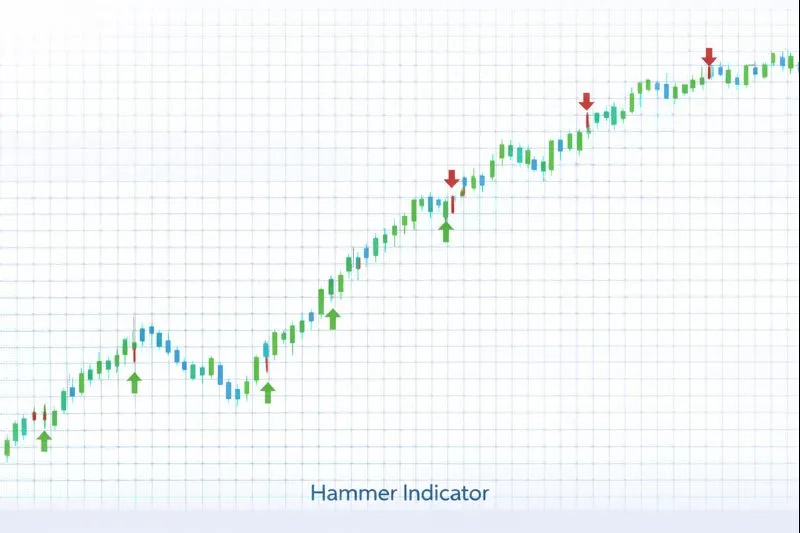
Shooting Star Indicator Explanation
The Shooting Star is a single-candlestick price action pattern that indicates potential bearish reversals by showing rejection of higher prices. The Shooting Star pattern has a small body at the bottom of the candle with a long upper wick (shadow) that is at least twice the length of the body, and little to no lower wick. The pattern resembles a shooting star, with the long upper wick representing the tail and the small body representing the head. The Shooting Star indicates that buyers pushed price up significantly during the period, but sellers rejected the higher prices and pushed price back down to close near the low. This rejection of higher prices suggests potential downward reversal, particularly when the Shooting Star forms at resistance levels or after an uptrend.
How Shooting Star Works: A Shooting Star is identified by its distinctive shape: a small body at the bottom with a long upper wick (at least 2 times the body length) and little to no lower wick. The body can be bullish (green/white) or bearish (red/black), but a bearish body is more significant. The long upper wick represents the rejection of higher prices, indicating that sellers stepped in to prevent further advance. The Shooting Star pattern is most effective when it occurs at resistance levels, after an uptrend, or with high volume. A Shooting Star at resistance suggests strong selling interest and potential downward reversal. The pattern should be confirmed by subsequent bearish price action for maximum reliability.
When to Use Shooting Star:
- Bearish Reversal Identification: Shooting Star patterns are highly effective at identifying potential bearish reversals, particularly when they form at resistance levels or after uptrends. The rejection of higher prices indicates strong selling interest and potential downward momentum.
- Resistance Level Confirmation: Shooting Star patterns can confirm resistance levels when they form at these key levels. A Shooting Star at resistance suggests that sellers are defending the level, potentially leading to downward reversal.
- Entry Signals: Shooting Star patterns can generate sell entry signals when they form at resistance or after uptrends, with a stop-loss above the Shooting Star's high. The pattern should be confirmed by subsequent bearish price action for maximum reliability.
Advantages:
- Provides clear visual signals of bearish reversal potential, making it easy to identify potential entry points. The distinctive shape makes Shooting Star patterns easy to spot on charts.
- Works effectively across multiple timeframes and asset classes, including stocks, forex, commodities, and cryptocurrencies. The pattern is universal and reflects human psychology in trading.
- Helps identify resistance levels and potential reversal points through price rejection, providing valuable information for risk management and trade placement.
Limitations:
- Shooting Star patterns can produce false signals in ranging markets when they occur frequently without clear directional bias. The pattern works best when combined with trend analysis and support/resistance levels.
- The indicator may require confirmation from subsequent price action, as Shooting Star patterns alone do not guarantee reversals. Not all Shooting Star patterns are equally reliable, and context is crucial.
- Shooting Star patterns alone do not provide information about trend direction or strength, only potential bearish reversal points. Traders should combine them with other indicators for more comprehensive analysis.
In summary, Shooting Star is a valuable price action pattern that identifies potential bearish reversals through rejection signals, making it ideal for identifying resistance levels and generating sell entry signals. For comprehensive understanding, refer to candlestick analysis literature, including Steve Nison's "Japanese Candlestick Charting Techniques" (1991), Investopedia's Shooting Star guide, TradingView's Shooting Star documentation, and academic research on candlestick patterns in technical analysis published in journals such as the Journal of Financial Markets and the Review of Financial Studies.
Practical Example: Using the Shooting Star Indicator in a Trading Strategy
The Shooting Star is a price action pattern used to identify potential bearish reversals through rejection signals. In a trading strategy, the Shooting Star indicator helps traders identify resistance levels and generate sell entry signals based on price rejection.
Scenario: You're creating a reversal strategy for EUR/USD on a 4-hour chart. You want to sell when a Shooting Star forms at a resistance level after an uptrend (indicating price rejection and potential downward reversal), with confirmation from subsequent bearish price action.
Strategy Logic:
- Identify Shooting Star patterns: a small body at the bottom with a long upper wick (at least 2x body length) and little to no lower wick. The pattern indicates rejection of higher prices.
- Sell signal: When a Shooting Star forms at a resistance level (e.g., previous high, trend line, Fibonacci retracement) after an uptrend, indicating strong selling interest and potential downward reversal.
- Confirmation: Wait for subsequent bearish price action (e.g., bearish candle closing below Shooting Star's low) before entering the trade.
Backtrader Example:
import backtrader as bt

class ShootingStarReversalStrategy(bt.Strategy):
    params = dict(
        shooting_star_wick_ratio=2.0  # Upper wick must be at least 2x body
    )

    def __init__(self):
        self.resistance_level = None  # Set based on your analysis
        self.shooting_star_bar = None  # Track Shooting Star bar

    def is_shooting_star(self, bar):
        """Check if current bar is a Shooting Star"""
        body = abs(bar.close - bar.open)
        lower_wick = min(bar.open, bar.close) - bar.low
        upper_wick = bar.high - max(bar.open, bar.close)
        # Small body at bottom, long upper wick, little lower wick
        return (body > 0 and
                upper_wick >= body * self.p.shooting_star_wick_ratio and
                lower_wick < body * 0.5)

    def next(self):
        current_bar = self.data[0]

        if not self.position:
            # Check for Shooting Star at resistance
            if (self.is_shooting_star(current_bar) and
                self.data.high[0] >= self.resistance_level * 0.999 and
                self.data.close[-5] < self.data.close[0]):  # Uptrend
                self.shooting_star_bar = current_bar
            # Confirm with bearish price action
            elif (self.shooting_star_bar is not None and
                  self.data.close[0] < self.shooting_star_bar.low):
                self.sell()
                self.shooting_star_bar = None
        else:
            # Exit on reversal or target
            if self._exit_signal():
                self.close()

    def _exit_signal(self):
        # Add exit logic
        return False

# Usage
cerebro = bt.Cerebro()
cerebro.addstrategy(ShootingStarReversalStrategy)
Expected Outcome: By using the Shooting Star indicator, your strategy identifies potential bearish reversals through rejection signals, helping you enter trades when price is rejected at resistance levels and exit when reversal patterns complete. This approach leads to better reversal identification, improved resistance recognition, and enhanced entry timing by trading price rejection patterns.
💡 Bonus Tip
Consider using Shooting Star patterns in combination with volume analysis for confirmation. When a Shooting Star forms with high volume, it suggests stronger rejection and higher probability of reversal. When a Shooting Star forms with low volume, it may be less reliable. This technique, documented in candlestick analysis literature, can significantly improve the accuracy of Shooting Star-based trading strategies.
Using the Shooting Star indicator ensures your strategy trades bearish reversal patterns effectively, improving entry and exit timing based on objective price action analysis.